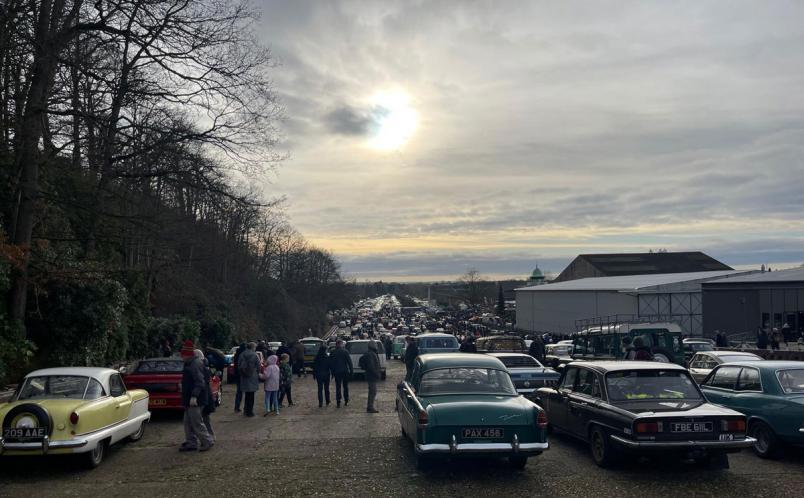
 It’s bracing, bracing I tell you! - what a cracking day!
Happy New Year and the first classic of the year was at Brooklands
13 January, 2026
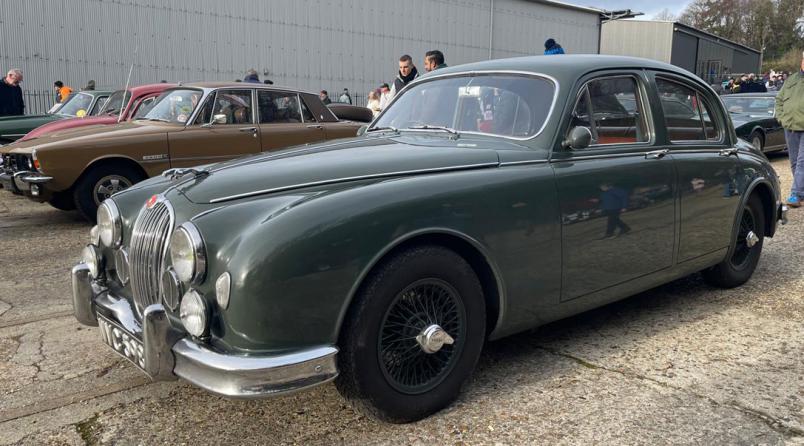
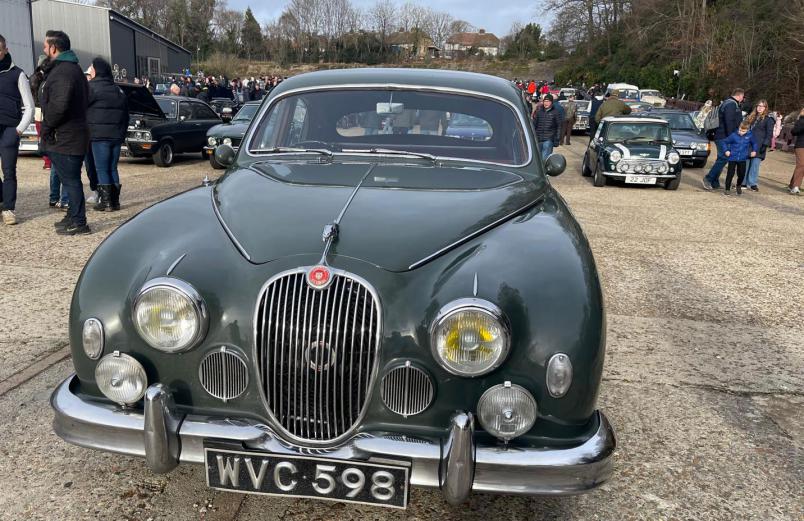 1958 Jaguar MK1 3.4litre
Brooklands New Years Day 2026
On a cool, brisk Thursday in Surrey on New Year's day 2026 at Brooklands in Surrey this Jaguar MK1 3.4 was on the tarmac.
It was itself registered on New Year's Day in 1958 and celebrating it's 68th birthday (just saving you the mental arithmetic there)
It's got a 3443cc engine under the bonnet and it did have the option of having the newly introduced (at the end of 1957) disc brakes on all four wheels.
The 3.4 was added to the MK1 line in February 1957, targeting the American market. The MK 1 was also the first monocoque car for Jaguar moving away from the "Body on-frame-chassis" and was a pivotal point in improbing the fortunes of Jaguar. It also weighed 283Kg less than the 1954 Jaguar VIIM 3.4 litre.
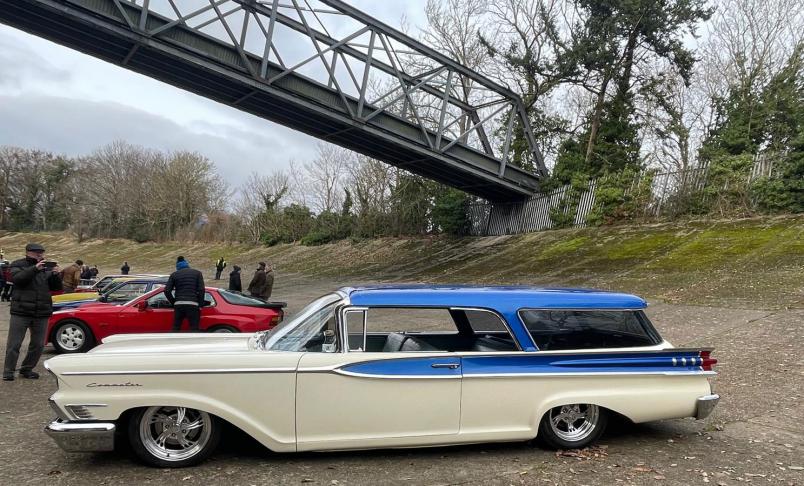 1959 Mercury Commuter
You don’t see many of these
This is a 1959 Mercury Commuter with a 6300cc engine under the bonnet and it's rare.
It's one of only 1,051 two-door versions produced in the 1959–60 model year.
By comparison, the four-door version had a longer production term and produced 15,122 units.
It features a three-speed, rear-wheel-drive automatic transmission and is powered by a Mercury Marauder 430-cubic-inch V8 engine.
The interior is spacious, offering plenty of legroom. The bench seats comfortably accommodate six people, with ample headroom and generous luggage space.
How long is it? The Mercury measures 218.6 inches in length. To put that into perspective, it’s 27.6 inches longer than the Jaguar 2.4, 3.4, and 3.8 models, which come in at 181 inches.
Width-wise, at 80.7 inches, it’s 13 inches wider than the Jaguar.
The estimated shipping/curb weight of the Mercury Commuter is 2,080 kg (4,590 lbs), which is some 645 kg (1,430 lbs) heavier than the 1957 Jaguar 3.4 Saloon with automatic transmission. The Jaguar has a shipping/curb weight of 1,435 kg (3,160 lbs).
Performance
The Mercury is capable of accelerating from 0–60 mph in 10.1 seconds, from 0–100 km/h in 10.7 seconds, and from 0–160 km/h (100 mph) in 31.7 seconds, with a top speed of 116 mph.
Economics
Fuel capacity is 76 litres (20.1 U.S. gallons / 16.7 imperial gallons).
At speeds of up to 62 mph (100 km/h), fuel consumption ranges between 15.7 and 18.8 mpg, measured in imperial (UK) gallons.
In 1957, the Jaguar 3.4-litre Mk I automatic was tested by The Motor magazine and recorded a top speed of 119.8 mph (192.8 km/h) and acceleration from 0–60 mph in 11.2 seconds.
Fuel consumption of 21.1 miles per imperial gallon (13.4 litres per 100 km) was also recorded.
In the USA in 1959, petrol (gasoline) cost 30–31 cents per gallon. In the UK, it was priced at 4 shillings and sixpence (4s 6d) per imperial gallon, which equated to approximately 63 cents.
Can't quite get my head around this…
Yes, that was 31 cents per gallon, not per litre
So in the USA in 1959, it worked out at 8.2 cents per litre.
As the imperial gallon is about 20% larger than the U.S. gallon, a like-for-like comparison puts the 1959 UK versus USA price at the pump at roughly 63 cents versus 36 cents—making fuel around 75% more expensive in the UK.
Even though the Mercury uses more fuel, the much cheaper petrol in the USA means the Jaguar costs about $0.70–$1.07 more to drive 100 miles than the Mercury in their respective home markets.
But as the USA was the designated primary market for the 3.4 litre Jaguar
Big picture takeaway
- USA market: Jaguar cheaper to run than the Mercury
- UK market: Jaguar much cheaper to run than the Mercury
- Cross-market (Jag UK vs Mercury USA): Fuel price dominates, making the Mercury cheaper overall despite worse mpg
Members Bridge at Brooklands Racing Circuit
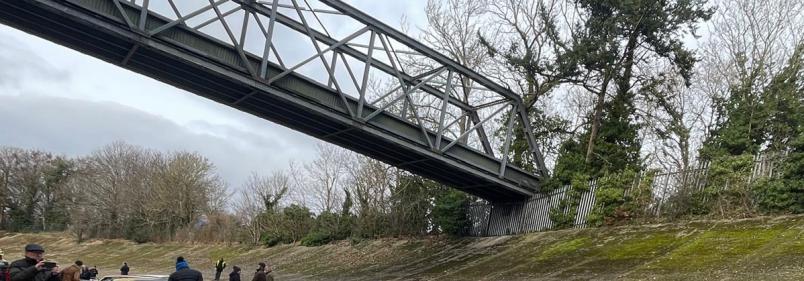 Members Bridge Replica at Brooklands Racing Circuit
The bridge in the background is not as old as the Brooklands circuit which opened in 1907.
This one is a replica of the original and positioned in the same place in 1988.
Until 1939 the members bridge provided spectacular views of the racing and was an iconic feature which can be seen in old photographs and film of the racing days. At the time the bridge led to the Members Restaurant situated at the top of the hill.
The racing circuit had it's last racing meeting in 1939, interrupted by the war, when the site was requistioned by the government to build aircraft to support the war effort. Repairs to damage caused to the circuit during the war proved to be too costly and the land was eventually sold.
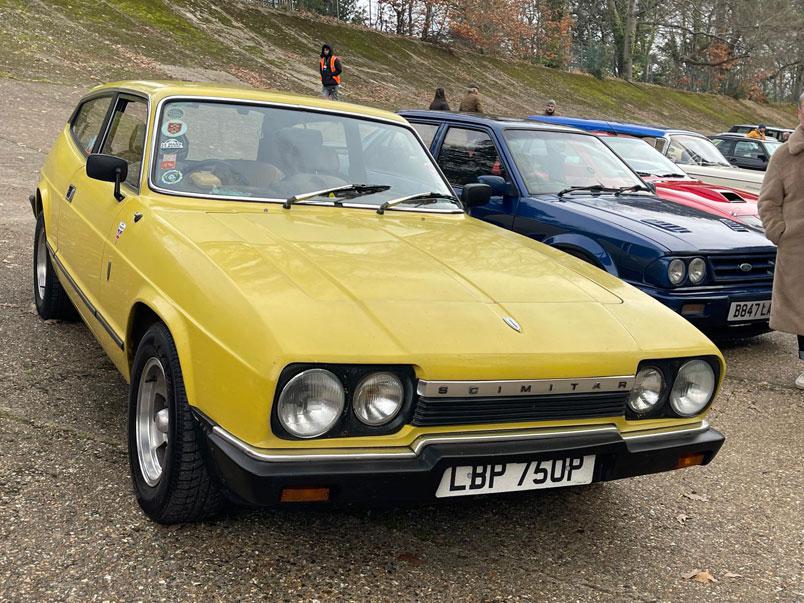 1976 Reliant Scimitar a mere half century under it’s belts with a 2994cc engine
A 1976 Reliant Scimitar, with a mere half-century under its belt.
It's got a steel ladder chassis with a with rust-free glass-reinforced plastic (GRP) top, fibreglass, to you and me.
This sporty classic was produced by the Reliant Motor Company, renowned for the three-wheeled Robin Reliant.
The previous Scimitar series — incorporating the Scimitar GTE SE5 (1968–1972) and SE5A (1972–1975) — were winners for Reliant
The GTE SE5 increased Reliant’s overall sales by 20 percent in its first year of production with 4,311 SE5s and 5,105 SE5As sold.
Not Many People Know This
At its peak during the 1970s, Reliant was the second-largest British car manufacturer behind British Leyland. Operating five factories, the company produced a wide range of vehicles and exported to seven countries.
The SE6
The SE6 was powered by the Ford Essex 3.0-litre (2994cc) V6 engine.
Production numbers were far lower than its predecessors, with just 543 SE6 models built, followed by 3,877 SE6A examples.
The SE6 featured a wheelbase extended by four inches over the SE5A, improving rear-seat legroom and easing access to the two-door sporting “estate.” The car was also three inches wider overall.
It retained the same engine, with optional overdrive on third and fourth gears and optional power steering from 1976.
Updates included larger headlamps and a switch from chrome-plated to rubber bumpers.
Pace
Performance remained impressive for the era, with a 0–60 mph time of 8.5 seconds and a top speed approaching 120 mph.
Later Developments
The Scimitar range continued to evolve into the 1980s with the Scimitar GTC convertible also known as the SE8B in 1980, alongside the arrival of the SE6B, which introduced a 2.8-litre Cologne V6 engine along with various mechanical and chassis updates.
Scimitar production finally came to an end in 1986 with the demise of the Reliant brand.
Well, nearly finally, but not quite.
Room for a last farewell….
In 1987, Middlebridge Engineering acquired the rights to the model and resumed limited production, introducing a 150 bhp 2.9-litre Cologne V6 with the choice of a five-speed manual gearbox or a four-speed automatic. The cars featured recalibrated suspension, new 15-inch alloy wheels, and colour-coded bumpers.
Alas, Middlebridge production ceased in 1990 after just 72 vehicles had been completed. Among them was Middlebridge Scimitar No. 5, ordered by HRH The Princess Royal—a long-time admirer of the Scimitar marque since 1970, when she was presented with an original Reliant-built Scimitar GTE as a joint 20th birthday and Christmas gift from Her Majesty The Queen and HRH The Duke of Edinburgh.
In total, seventy-two cars were completed, with a further five in production when economic realities intervened and Middlebridge was no more. The company’s assets—including moulds, jigs, partially built cars, and production rights—were subsequently sold off.
What a beauty
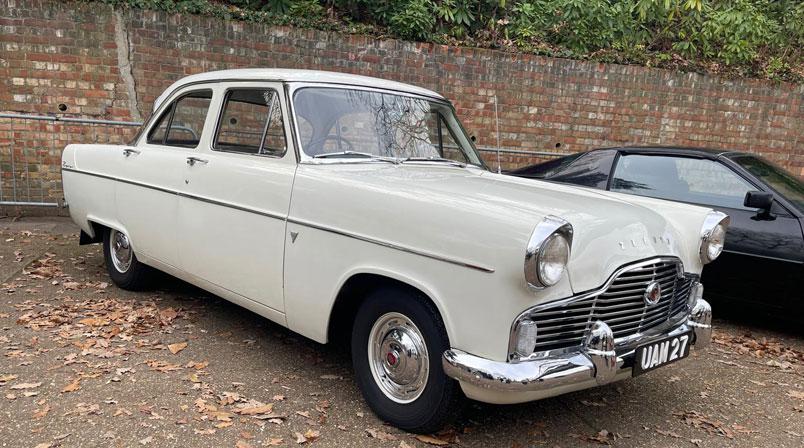 1959 Ford Zephyr registered 30th June 1959 with 2553cc under the bonnet
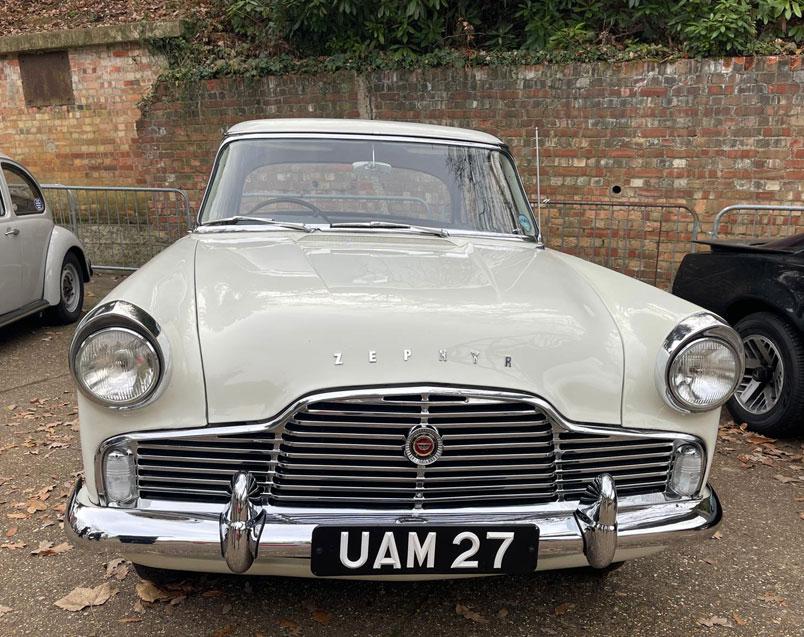 You wouldn’t want to miss the front end view, it’s a different era with 67 years
Another Cracker
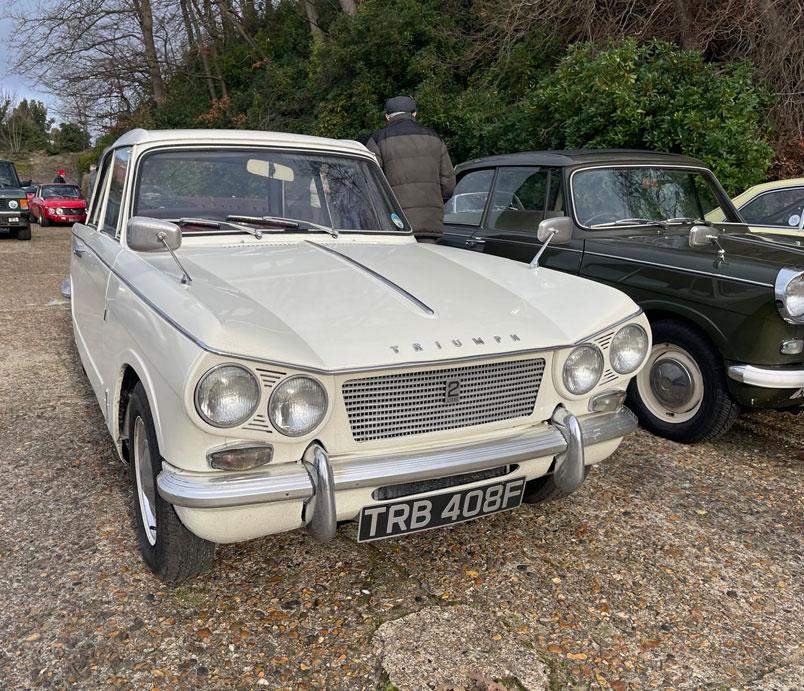 1967 Triumph Vitesse 2 litre (1998cc)
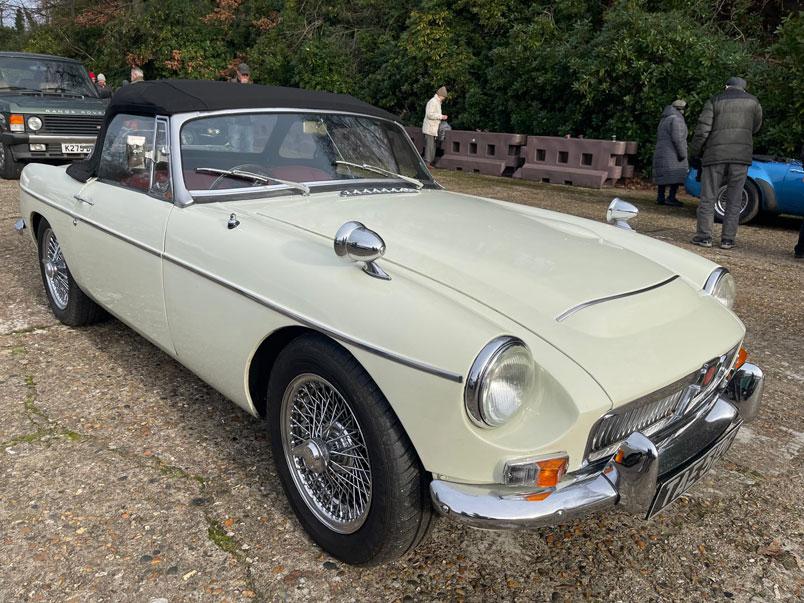 1969 MG C 2912cc - looks absolutely fantastic